1 Corinthians · Chapter 13 · Love
1 Corinthians 13:13 — Bible Verse Meaning & Context
Love is the centre of Scripture's story. Read this one slowly.
Reviewed by the Bible Verses editorial team · World English Bible & King James Version (public domain)
1 Corinthians 13:13 — read it now
WEB · World English Bible
“But now faith, hope, and love remain — these three. The greatest of these is love.”
KJV · King James Version
“And1161 now3570 abideth3306 faith4102, hope1680, charity26, these5023 three5140; but1161 the greatest3187 of these5130 is charity26.”
1 Corinthians 13:13-null · read in full chapter context →
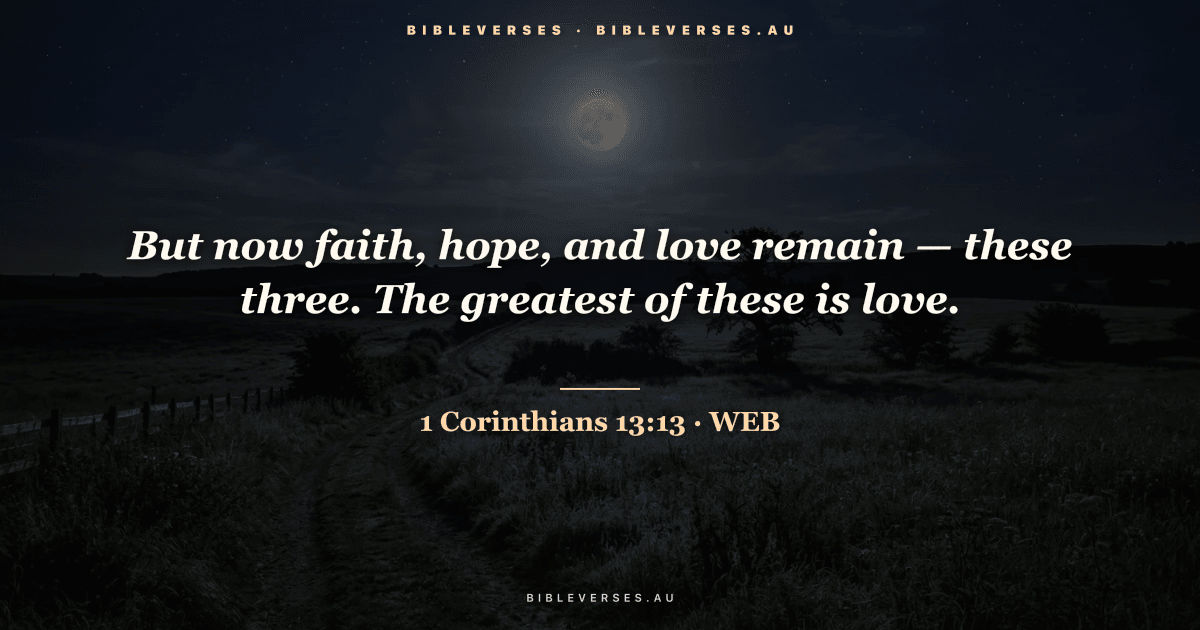
1080 × 1080 · Square
Background
— or pick from our presets below —
Processed locally — your photo never leaves your device.
Every download includes a small bibleverses.au mark so others can find us too.
WEB vs KJV — how they differ
The WEB is a modern public-domain revision of the 1901 American Standard Version; the KJV dates to 1611. For 1 Corinthians 13:13, the KJV uses abideth, charity, while the WEB renders these as love, remain. Both translate the same underlying Greek or Hebrew text — the differences are stylistic, not theological.
In context
1 Corinthians 13:13 in 1 Corinthians 13
A Bible verse rarely stands alone. Here is 1 Corinthians 13:13 read with the verses immediately before and after — the surrounding flow of 1 Corinthians 13. Read the full chapter →
- v.11 When I was a child, I spoke as a child, I felt as a child, I thought as a child. Now that I have become a man, I have put away childish things.
- v.12 For now we see in a mirror, dimly, but then face to face. Now I know in part, but then I will know fully, even as I was also fully known.
- v.13 But now faith, hope, and love remain — these three. The greatest of these is love.
Book background
About the Book of 1 Corinthians
- Testament
- New Testament
- Genre
- Pauline epistle
- Author
- Paul
- Date written
- c. 55 AD
- Audience
- A divided, immature church in cosmopolitan Corinth
- Chapters
- 16
1 Corinthians addresses divisions, immorality, lawsuits, marriage, idol food, worship disorder, and confusion about the resurrection in a young church. It contains the great love chapter (13) and Paul's definitive teaching on the resurrection of the body (15).
Setting: Written from Ephesus to address reported problems.
Key themes: unity · wisdom · cross · spiritual gifts · love · resurrection
Memorisation aid
How to memorise 1 Corinthians 13:13
1 Corinthians 13:13 contains 16 words in 5 clauses. Learn one clause at a time, then chain them. The first-letter mnemonic (FLM) under each clause is a memory hook — once you can speak the FLM from memory, the full clause follows.
- 1
But now faith
BNF
- 2
hope
H
- 3
and love remain
ALR
- 4
these three
TT
- 5
The greatest of these is love.
TGOTIL
Frequently asked
FAQ about 1 Corinthians 13:13
What does 1 Corinthians 13:13 say?
1 Corinthians 13:13 reads: "But now faith, hope, and love remain — these three. The greatest of these is love." — from the New Testament, 1 Corinthians (Pauline epistle). The full verse is shown above with both the World English Bible (WEB) and King James Version (KJV) translations side by side.
What book of the Bible is 1 Corinthians 13:13 in?
1 Corinthians 13:13 is in the book of 1 Corinthians, traditionally attributed to Paul and written around c. 55 AD. 1 Corinthians is pauline epistle in the New Testament, originally addressed to A divided, immature church in cosmopolitan Corinth. Best known for the "love" chapter (1 Corinthians 13).
What is 1 Corinthians 13:13 about?
1 Corinthians 13:13 is primarily a Bible verse about Love, with related themes including Faith, Hope. Within 1 Corinthians, 1 Corinthians addresses divisions, immorality, lawsuits, marriage, idol food, worship disorder, and confusion about the resurrection in a young church. Read the full passage above with surrounding context.
What is the difference between 1 Corinthians 13:13 in WEB and KJV?
1 Corinthians 13:13 in the World English Bible (WEB) reads: "But now faith, hope, and love remain — these three. The greatest of these is love.". The King James Version (KJV) reads: "And1161 now3570 abideth3306 faith4102, hope1680, charity26, these5023 three5140; but1161 the greatest3187 of these5130 is charity26.". The WEB is a modern public-domain translation that updates the KJV's 1611 English while keeping a similar formal-equivalence style. Both render the same underlying Greek or Hebrew text.
How long is 1 Corinthians 13:13?
1 Corinthians 13:13 is 16 words in the WEB translation (82 characters), broken into 5 clauses. It is short and well-suited to memorisation. Estimated reading time is about 5 seconds.
How can I memorise 1 Corinthians 13:13?
To memorise 1 Corinthians 13:13, split it into its 5 natural clauses and learn one at a time. Repeat the full verse out loud five times, then write it from memory. Saving the verse as a photo wallpaper using our verse image studio helps daily review — the visual association with a memorable background dramatically improves recall.
Why does 1 Corinthians 13:13 matter in 1 Corinthians?
1 Corinthians addresses divisions, immorality, lawsuits, marriage, idol food, worship disorder, and confusion about the resurrection in a young church. It contains the great love chapter (13) and Paul's definitive teaching on the resurrection of the body (15). 1 Corinthians 13:13 sits within this larger story — 1 Corinthians as a whole emphasises unity, wisdom, cross.
How can I apply 1 Corinthians 13:13 today?
Many readers use 1 Corinthians 13:13 as a daily reminder verse — saving it as a phone wallpaper, sharing it on Pinterest, or memorising it for prayer. The verse studio on this page lets you download 1 Corinthians 13:13 on 52 different backgrounds for free. Pair the verse with the surrounding chapter context shown above to understand its full meaning before applying it.
More designs
10 verses to read next
A fresh set of verses every visit — each on its own photo background. Tap any card to open the full study page.
-

John 3:16
“For God so loved the world, that he gave his one and only Son, that whoever believes in him should not perish, but have eternal life.”
Read context →
-

Romans 8:28
“We know that all things work together for good for those who love God, for those who are called according to his purpose.”
Read context →
-

1 John 4:8
“He who doesn't love doesn't know God, for God is love.”
Read context →
-

1 Corinthians 13:4-7
“Love is patient and is kind. Love doesn't envy. Love doesn't brag, is not proud, doesn't behave itself inappropriately, doesn't seek its own way, is not pr…”
Read context →
-

Matthew 22:39
“A second likewise is this, ‘You shall love your neighbor as yourself.’”
Read context →
-

John 13:34
“A new commandment I give to you, that you love one another. Just as I have loved you, you also love one another.”
Read context →
-

Romans 5:8
“But God commends his own love toward us, in that while we were yet sinners, Christ died for us.”
Read context →
-

Ephesians 4:32
“And be kind to one another, tender hearted, forgiving each other, just as God also in Christ forgave you.”
Read context →
-

Deuteronomy 6:5
“You shall love Yahweh your God with all your heart, with all your soul, and with all your might.”
Read context →
-
Ruth 1:16
“Ruth said, “Don’t urge me to leave you, and to return from following you, for where you go, I will go; and where you stay, I will stay. Your people will be…”
Read context →
More featured verses in 1 Corinthians 13
Read full chapter → 1 Corinthians 13:4-7
“Love is patient and is kind. Love doesn't envy. Love doesn't brag, is not proud, doesn't behave itself inappropriately, doesn't seek its own way, is not pr…”
Read context →

1 Corinthians 13:5
“doesn’t behave itself inappropriately, doesn’t seek its own way, is not provoked, takes no account of evil;”
Read context →

1 Corinthians 13:6
“doesn’t rejoice in unrighteousness, but rejoices with the truth;”
Read context →
1 Corinthians 13:7
“bears all things, believes all things, hopes all things, endures all things.”
Read context →
More featured verses in 1 Corinthians
Browse 1 Corinthians → 1 Corinthians 10:13
“No temptation has taken you except what is common to man. God is faithful, who will not allow you to be tempted above what you are able, but will with the…”
Read context →

1 Corinthians 6:19
“Or don’t you know that your body is a temple of the Holy Spirit who is in you, whom you have from God? You are not your own,”
Read context →