Psalms · Chapter 91 · Faith
Psalms 91:2 — Bible Verse Meaning & Context
Trust does not require seeing. Keep this close.
Reviewed by the Bible Verses editorial team · World English Bible & King James Version (public domain)
Psalms 91:2 — read it now
WEB · World English Bible
“I will say of Yahweh, “He is my refuge and my fortress; my God, in whom I trust.””
KJV · King James Version
“I will say559 of the LORD3068, He is my refuge4268 and my fortress4686: my God430; in him will I trust982.”
Psalms 91:2-null · read in full chapter context →
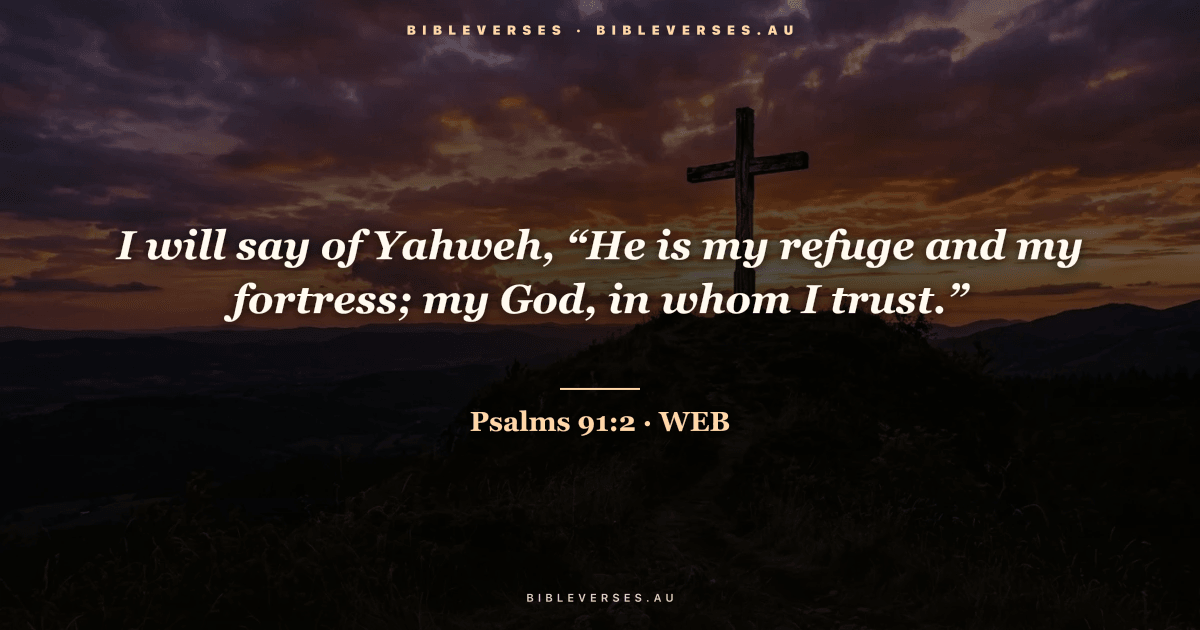
1080 × 1080 · Square
Background
— or pick from our presets below —
Processed locally — your photo never leaves your device.
Every download includes a small bibleverses.au mark so others can find us too.
WEB vs KJV — how they differ
The WEB is a modern public-domain revision of the 1901 American Standard Version; the KJV dates to 1611. For Psalms 91:2, the KJV uses the, lord, him, while the WEB renders these as yahweh, whom. Both translate the same underlying Greek or Hebrew text — the differences are stylistic, not theological.
In context
Psalms 91:2 in Psalms 91
A Bible verse rarely stands alone. Here is Psalms 91:2 read with the verses immediately before and after — the surrounding flow of Psalms 91. Read the full chapter →
- v.1 He who dwells in the secret place of the Most High will rest in the shadow of the Almighty.
- v.2 I will say of Yahweh, “He is my refuge and my fortress; my God, in whom I trust.”
- v.3 For he will deliver you from the snare of the fowler, and from the deadly pestilence.
- v.4 He will cover you with his feathers. Under his wings you will take refuge. His faithfulness is your shield and rampart.
Book background
About the Book of Psalms
- Testament
- Old Testament
- Genre
- Hebrew poetry
- Author
- David (73 psalms), Asaph, Sons of Korah, Solomon, Moses, others
- Date written
- c. 1410–430 BC (compiled over a millennium)
- Audience
- All of Israel's worshipping community — and the church
- Chapters
- 150
The Psalms are 150 inspired songs and prayers covering every emotion the human heart knows — praise, lament, confession, thanksgiving, anger, longing. About half are attributed to David. The book is divided into five "books," each ending with a doxology. The Psalms shape Christian prayer more than any other Old Testament book and are quoted in the New Testament more than any other.
Setting: 150 sacred songs used in temple worship; the Bible's songbook.
Key themes: worship · lament · trust · kingship · thanksgiving
Memorisation aid
How to memorise Psalms 91:2
Psalms 91:2 contains 18 words in 4 clauses. Learn one clause at a time, then chain them. The first-letter mnemonic (FLM) under each clause is a memory hook — once you can speak the FLM from memory, the full clause follows.
- 1
I will say of Yahweh
IWSOY
- 2
“He is my refuge and my fortress
HIMRAM
- 3
my God
MG
- 4
in whom I trust.”
IWIT
Frequently asked
FAQ about Psalms 91:2
What does Psalms 91:2 say?
Psalms 91:2 reads: "I will say of Yahweh, “He is my refuge and my fortress; my God, in whom I trust.”" — from the Old Testament, Psalms (Hebrew poetry). The full verse is shown above with both the World English Bible (WEB) and King James Version (KJV) translations side by side.
What book of the Bible is Psalms 91:2 in?
Psalms 91:2 is in the book of Psalms, traditionally attributed to David (73 psalms), Asaph, Sons of Korah, Solomon, Moses, others and written around c. 1410–430 BC (compiled over a millennium). Psalms is hebrew poetry in the Old Testament, originally addressed to All of Israel's worshipping community — and the church. Best known for Psalm 23 ("The LORD is my shepherd") and Psalm 51.
What is Psalms 91:2 about?
Psalms 91:2 is primarily a Bible verse about Faith. Within Psalms, The Psalms are 150 inspired songs and prayers covering every emotion the human heart knows — praise, lament, confession, thanksgiving, anger, longing. Read the full passage above with surrounding context.
What is the difference between Psalms 91:2 in WEB and KJV?
Psalms 91:2 in the World English Bible (WEB) reads: "I will say of Yahweh, “He is my refuge and my fortress; my God, in whom I trust.”". The King James Version (KJV) reads: "I will say559 of the LORD3068, He is my refuge4268 and my fortress4686: my God430; in him will I trust982.". The WEB is a modern public-domain translation that updates the KJV's 1611 English while keeping a similar formal-equivalence style. Both render the same underlying Greek or Hebrew text.
How long is Psalms 91:2?
Psalms 91:2 is 18 words in the WEB translation (81 characters), broken into 4 clauses. It is short and well-suited to memorisation. Estimated reading time is about 5 seconds.
How can I memorise Psalms 91:2?
To memorise Psalms 91:2, split it into its 4 natural clauses and learn one at a time. Repeat the full verse out loud five times, then write it from memory. Saving the verse as a photo wallpaper using our verse image studio helps daily review — the visual association with a memorable background dramatically improves recall.
Why does Psalms 91:2 matter in Psalms?
The Psalms are 150 inspired songs and prayers covering every emotion the human heart knows — praise, lament, confession, thanksgiving, anger, longing. About half are attributed to David. The book is divided into five "books," each ending with a doxology. The Psalms shape Christian prayer more than any other Old Testament book and are quoted in the New Testament more than any other. Psalms 91:2 sits within this larger story — Psalms as a whole emphasises worship, lament, trust.
How can I apply Psalms 91:2 today?
Many readers use Psalms 91:2 as a daily reminder verse — saving it as a phone wallpaper, sharing it on Pinterest, or memorising it for prayer. The verse studio on this page lets you download Psalms 91:2 on 52 different backgrounds for free. Pair the verse with the surrounding chapter context shown above to understand its full meaning before applying it.
More designs
10 verses to read next
A fresh set of verses every visit — each on its own photo background. Tap any card to open the full study page.
-
Psalms 23:1
“A Psalm by David. Yahweh is my shepherd: I shall lack nothing.”
Read context →
-
John 3:16
“For God so loved the world, that he gave his one and only Son, that whoever believes in him should not perish, but have eternal life.”
Read context →
-

Philippians 4:13
“I can do all things through Christ, who strengthens me.”
Read context →
-
Romans 8:28
“We know that all things work together for good for those who love God, for those who are called according to his purpose.”
Read context →
-

Matthew 6:33
“But seek first God’s Kingdom, and his righteousness; and all these things will be given to you as well.”
Read context →
-

1 John 4:8
“He who doesn't love doesn't know God, for God is love.”
Read context →
-
Hebrews 11:1
“Now faith is assurance of things hoped for, proof of things not seen.”
Read context →
-
Psalm 23:1
“Yahweh is my shepherd: I shall lack nothing.”
Read context →
-
Proverbs 3:6
“In all your ways acknowledge him, and he will make your paths straight.”
Read context →
-
Matthew 7:7
““Ask, and it will be given you. Seek, and you will find. Knock, and it will be opened for you.”
Read context →
More featured verses in Psalms 91
Read full chapter →
More featured verses in Psalms
Browse Psalms → Psalms 23:1
“A Psalm by David. Yahweh is my shepherd: I shall lack nothing.”
Read context →
Psalm 23:1
“Yahweh is my shepherd: I shall lack nothing.”
Read context →
Psalms 23:4
“Even though I walk through the valley of the shadow of death, I will fear no evil, for you are with me. Your rod and your staff, they comfort me.”
Read context →
Psalms 27:1
“By David. Yahweh is my light and my salvation. Whom shall I fear? Yahweh is the strength of my life. Of whom shall I be afraid?”
Read context →