Psalms · Chapter 23 · Faith
Psalm 23:1 — Bible Verse Meaning & Context
Trust does not require seeing. Keep this close.
Reviewed by the Bible Verses editorial team · World English Bible & King James Version (public domain)
Psalm 23:1 — read it now
WEB · World English Bible
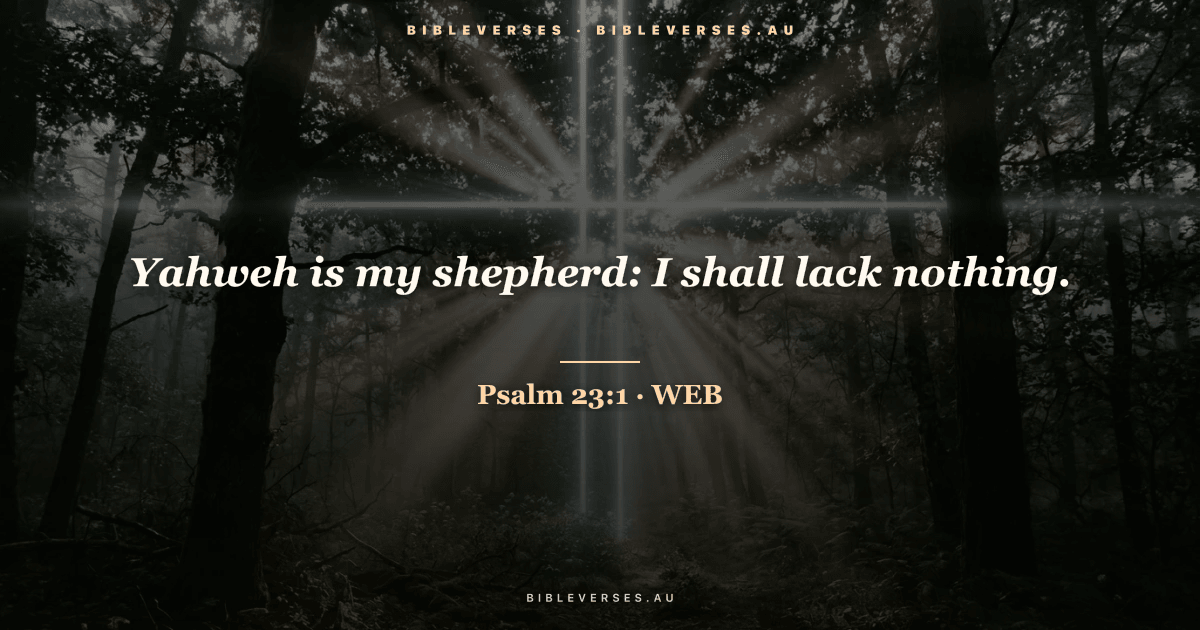
“Yahweh is my shepherd: I shall lack nothing.”
KJV · King James Version
“The LORD is my shepherd; I shall not want.”
Psalms 23:1-null · read in full chapter context →
1080 × 1080 · Square
Background
— or pick from our presets below —
Processed locally — your photo never leaves your device.
Every download includes a small bibleverses.au mark so others can find us too.
About Psalm 23:1
This single line opens the most beloved psalm in the Hebrew Scriptures. Six words in Hebrew, it sets a tone the rest of the psalm will deepen: God is the shepherd, the speaker is the sheep, and on the basis of that relationship nothing essential is missing.
The metaphor is intimate. David, the traditional author, spent his youth as a shepherd, watching over his father's flock outside Bethlehem. He knew the work from the inside — the constant attention, the search for water, the protection from predators, the slow leading of the flock from one pasture to the next. To call God a shepherd is not poetic flourish; it is precise.
The KJV phrase "I shall not want" can sound antiquated to modern ears. Want here is the older sense of lack. The WEB renders it directly: "I shall lack nothing." The point is not that desire ceases, but that the essentials of life — guidance, sustenance, safety, presence — are reliably supplied.
Psalm 23 is read at hospital bedsides, at funerals, at weddings, in seasons of fear and seasons of gratitude. Its first line is the foundation everything else rests on. If God truly shepherds, then the green pastures, still waters, restored soul, and right paths of the verses that follow are not wishful thinking — they are the natural fruit of being well-led.
For anyone walking through scarcity, real or felt, the first verse is the one to return to. Not because the lack disappears, but because the Shepherd does not.
WEB vs KJV — how they differ
The WEB is a modern public-domain revision of the 1901 American Standard Version; the KJV dates to 1611. For Psalm 23:1, the KJV uses the, lord, not, want, while the WEB renders these as yahweh, lack, nothing. Both translate the same underlying Greek or Hebrew text — the differences are stylistic, not theological.
In context
Psalm 23:1 in Psalms 23
A Bible verse rarely stands alone. Here is Psalm 23:1 read with the verses immediately before and after — the surrounding flow of Psalms 23. Read the full chapter →
- v.1 A Psalm by David. Yahweh is my shepherd: I shall lack nothing.
- v.2 He makes me lie down in green pastures. He leads me beside still waters.
- v.3 He restores my soul. He guides me in the paths of righteousness for his name’s sake.
Book background
About the Book of Psalms
- Testament
- Old Testament
- Genre
- Hebrew poetry
- Author
- David (73 psalms), Asaph, Sons of Korah, Solomon, Moses, others
- Date written
- c. 1410–430 BC (compiled over a millennium)
- Audience
- All of Israel's worshipping community — and the church
- Chapters
- 150
The Psalms are 150 inspired songs and prayers covering every emotion the human heart knows — praise, lament, confession, thanksgiving, anger, longing. About half are attributed to David. The book is divided into five "books," each ending with a doxology. The Psalms shape Christian prayer more than any other Old Testament book and are quoted in the New Testament more than any other.
Setting: 150 sacred songs used in temple worship; the Bible's songbook.
Key themes: worship · lament · trust · kingship · thanksgiving
Frequently asked
FAQ about Psalm 23:1
What does Psalm 23:1 say?
Psalm 23:1 reads: "Yahweh is my shepherd: I shall lack nothing." — from the Old Testament, Psalms (Hebrew poetry). The full verse is shown above with both the World English Bible (WEB) and King James Version (KJV) translations side by side.
What book of the Bible is Psalm 23:1 in?
Psalm 23:1 is in the book of Psalms, traditionally attributed to David (73 psalms), Asaph, Sons of Korah, Solomon, Moses, others and written around c. 1410–430 BC (compiled over a millennium). Psalms is hebrew poetry in the Old Testament, originally addressed to All of Israel's worshipping community — and the church. Best known for Psalm 23 ("The LORD is my shepherd") and Psalm 51.
What is Psalm 23:1 about?
Psalm 23:1 is primarily a Bible verse about Faith, with related themes including Hope, Peace. Within Psalms, The Psalms are 150 inspired songs and prayers covering every emotion the human heart knows — praise, lament, confession, thanksgiving, anger, longing. Read the full passage above with surrounding context.
What is the difference between Psalm 23:1 in WEB and KJV?
Psalm 23:1 in the World English Bible (WEB) reads: "Yahweh is my shepherd: I shall lack nothing.". The King James Version (KJV) reads: "The LORD is my shepherd; I shall not want.". The WEB is a modern public-domain translation that updates the KJV's 1611 English while keeping a similar formal-equivalence style. Both render the same underlying Greek or Hebrew text.
How long is Psalm 23:1?
Psalm 23:1 is 8 words in the WEB translation (44 characters), broken into 1 clause. It is short and well-suited to memorisation. Estimated reading time is about 3 seconds.
How can I memorise Psalm 23:1?
To memorise Psalm 23:1, split it into its 1 natural clause and learn one at a time. Repeat the full verse out loud five times, then write it from memory. Saving the verse as a photo wallpaper using our verse image studio helps daily review — the visual association with a memorable background dramatically improves recall.
Why does Psalm 23:1 matter in Psalms?
The Psalms are 150 inspired songs and prayers covering every emotion the human heart knows — praise, lament, confession, thanksgiving, anger, longing. About half are attributed to David. The book is divided into five "books," each ending with a doxology. The Psalms shape Christian prayer more than any other Old Testament book and are quoted in the New Testament more than any other. Psalm 23:1 sits within this larger story — Psalms as a whole emphasises worship, lament, trust.
How can I apply Psalm 23:1 today?
Many readers use Psalm 23:1 as a daily reminder verse — saving it as a phone wallpaper, sharing it on Pinterest, or memorising it for prayer. The verse studio on this page lets you download Psalm 23:1 on 52 different backgrounds for free. Pair the verse with the surrounding chapter context shown above to understand its full meaning before applying it.
More designs
10 verses to read next
A fresh set of verses every visit — each on its own photo background. Tap any card to open the full study page.
-

Philippians 4:13
“I can do all things through Christ, who strengthens me.”
Read context →
-

Jeremiah 29:11
“For I know the thoughts that I think toward you, says Yahweh, thoughts of peace, and not of evil, to give you hope and a latter end.”
Read context →
-

Psalm 46:1
“God is our refuge and strength, a very present help in trouble.”
Read context →
-

Psalms 23:1
“A Psalm by David. Yahweh is my shepherd: I shall lack nothing.”
Read context →
-

John 3:16
“For God so loved the world, that he gave his one and only Son, that whoever believes in him should not perish, but have eternal life.”
Read context →
-

Romans 8:28
“We know that all things work together for good for those who love God, for those who are called according to his purpose.”
Read context →
-

Matthew 6:33
“But seek first God’s Kingdom, and his righteousness; and all these things will be given to you as well.”
Read context →
-

1 John 4:8
“He who doesn't love doesn't know God, for God is love.”
Read context →
-

Hebrews 11:1
“Now faith is assurance of things hoped for, proof of things not seen.”
Read context →
-

Proverbs 3:6
“In all your ways acknowledge him, and he will make your paths straight.”
Read context →
More featured verses in Psalms 23
Read full chapter →More featured verses in Psalms
Browse Psalms →
Psalms 27:1
“By David. Yahweh is my light and my salvation. Whom shall I fear? Yahweh is the strength of my life. Of whom shall I be afraid?”
Read context →

Psalm 42:11
“Why are you in despair, my soul? Why are you disturbed within me? Hope in God! For I shall still praise him, the saving help of my countenance, and my God.”
Read context →
Psalm 46:1
“God is our refuge and strength, a very present help in trouble.”
Read context →

Psalms 46:1
“For the Chief Musician. By the sons of Korah. According to Alamoth. God is our refuge and strength, a very present help in trouble.”
Read context →