2 Corinthians · Chapter 4 · Faith
2 Corinthians 4:18 — Bible Verse Meaning & Context
Trust does not require seeing. Keep this close.
Reviewed by the Bible Verses editorial team · World English Bible & King James Version (public domain)
2 Corinthians 4:18 — read it now
WEB · World English Bible
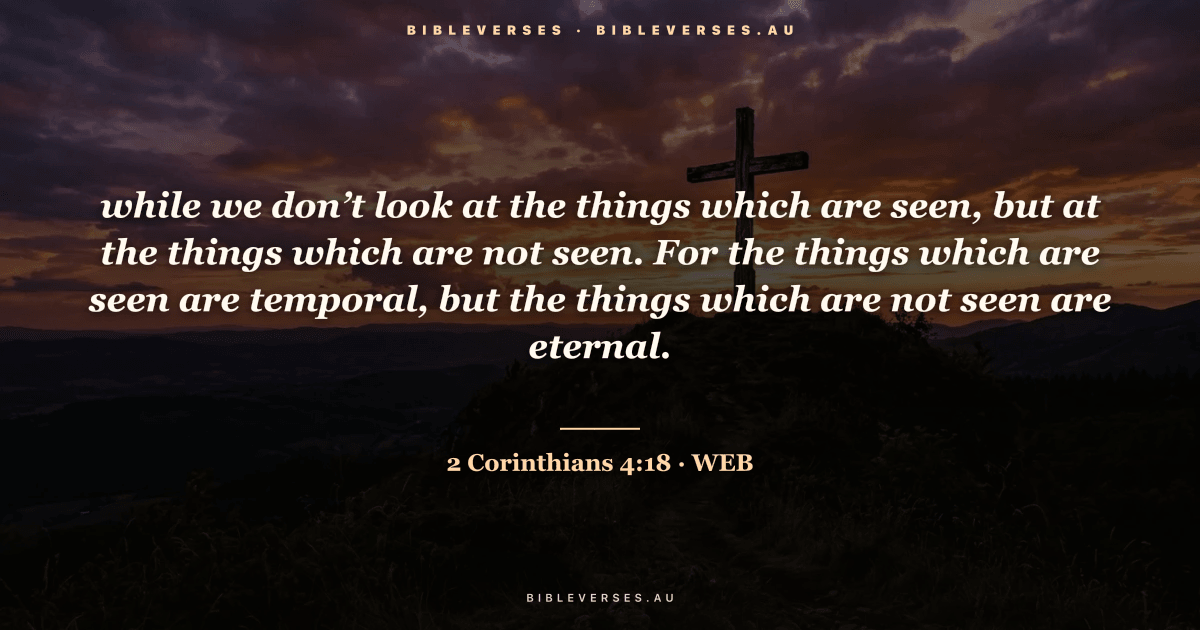
“while we don’t look at the things which are seen, but at the things which are not seen. For the things which are seen are temporal, but the things which are not seen are eternal.”
KJV · King James Version
“While4648 we2257 look4648 not3361 at4648 the things which are seen991, but235 at the things which are991 not3361 seen991: for1063 the things which are seen991 are temporal4340; but1161 the things which are991 not3361 seen991 are eternal166.”
2 Corinthians 4:18-null · read in full chapter context →
1080 × 1080 · Square
Background
— or pick from our presets below —
Processed locally — your photo never leaves your device.
Every download includes a small bibleverses.au mark so others can find us too.
WEB vs KJV — how they differ
The WEB is a modern public-domain revision of the 1901 American Standard Version; the KJV dates to 1611. the WEB renders these as don. Both translate the same underlying Greek or Hebrew text — the differences are stylistic, not theological.
In context
2 Corinthians 4:18 in 2 Corinthians 4
A Bible verse rarely stands alone. Here is 2 Corinthians 4:18 read with the verses immediately before and after — the surrounding flow of 2 Corinthians 4. Read the full chapter →
- v.16 Therefore we don’t faint, but though our outward man is decaying, yet our inward man is renewed day by day.
- v.17 For our light affliction, which is for the moment, works for us more and more exceedingly an eternal weight of glory;
- v.18 while we don’t look at the things which are seen, but at the things which are not seen. For the things which are seen are temporal, but the things which are not seen are eternal.
Book background
About the Book of 2 Corinthians
- Testament
- New Testament
- Genre
- Pauline epistle
- Author
- Paul
- Date written
- c. 55–56 AD
- Audience
- The church at Corinth, after Paul's tense exchange with them
- Chapters
- 13
2 Corinthians is Paul's most personal letter — defending his apostolic ministry, describing the "treasure in jars of clay" (4:7), the new creation in Christ (5:17), and his own "thorn in the flesh." Its theme: God's strength is made perfect in human weakness (12:9).
Setting: The most personal of Paul's letters — written from Macedonia.
Key themes: weakness · comfort · reconciliation · ministry · giving
Memorisation aid
How to memorise 2 Corinthians 4:18
2 Corinthians 4:18 contains 35 words in 4 clauses. Learn one clause at a time, then chain them. The first-letter mnemonic (FLM) under each clause is a memory hook — once you can speak the FLM from memory, the full clause follows.
- 1
while we don’t look at the things which are seen
WWDLAT
- 2
but at the things which are not seen
BATTWA
- 3
For the things which are seen are temporal
FTTWAS
- 4
but the things which are not seen are eternal.
BTTWAN
Frequently asked
FAQ about 2 Corinthians 4:18
What does 2 Corinthians 4:18 say?
2 Corinthians 4:18 reads: "while we don’t look at the things which are seen, but at the things which are not seen. For the things which are seen are temporal, but the things which are not seen are eternal." — from the New Testament, 2 Corinthians (Pauline epistle). The full verse is shown above with both the World English Bible (WEB) and King James Version (KJV) translations side by side.
What book of the Bible is 2 Corinthians 4:18 in?
2 Corinthians 4:18 is in the book of 2 Corinthians, traditionally attributed to Paul and written around c. 55–56 AD. 2 Corinthians is pauline epistle in the New Testament, originally addressed to The church at Corinth, after Paul's tense exchange with them. Best known for "my grace is sufficient for you".
What is 2 Corinthians 4:18 about?
2 Corinthians 4:18 is primarily a Bible verse about Faith. Within 2 Corinthians, 2 Corinthians is Paul's most personal letter — defending his apostolic ministry, describing the "treasure in jars of clay" (4:7), the new creation in Christ (5:17), and his own "thorn in the flesh. Read the full passage above with surrounding context.
What is the difference between 2 Corinthians 4:18 in WEB and KJV?
2 Corinthians 4:18 in the World English Bible (WEB) reads: "while we don’t look at the things which are seen, but at the things which are not seen. For the things which are seen are temporal, but the things which are not seen are eternal.". The King James Version (KJV) reads: "While4648 we2257 look4648 not3361 at4648 the things which are seen991, but235 at the things which are991 not3361 seen991: for1063 the things which are seen991 are temporal4340; but1161 the things which are991 not3361 seen991 are eternal166.". The WEB is a modern public-domain translation that updates the KJV's 1611 English while keeping a similar formal-equivalence style. Both render the same underlying Greek or Hebrew text.
How long is 2 Corinthians 4:18?
2 Corinthians 4:18 is 35 words in the WEB translation (178 characters), broken into 4 clauses. It is a longer verse, often broken into smaller phrases for memorisation. Estimated reading time is about 11 seconds.
How can I memorise 2 Corinthians 4:18?
To memorise 2 Corinthians 4:18, split it into its 4 natural clauses and learn one at a time. Repeat the full verse out loud five times, then write it from memory. Saving the verse as a photo wallpaper using our verse image studio helps daily review — the visual association with a memorable background dramatically improves recall.
Why does 2 Corinthians 4:18 matter in 2 Corinthians?
2 Corinthians is Paul's most personal letter — defending his apostolic ministry, describing the "treasure in jars of clay" (4:7), the new creation in Christ (5:17), and his own "thorn in the flesh." Its theme: God's strength is made perfect in human weakness (12:9). 2 Corinthians 4:18 sits within this larger story — 2 Corinthians as a whole emphasises weakness, comfort, reconciliation.
How can I apply 2 Corinthians 4:18 today?
Many readers use 2 Corinthians 4:18 as a daily reminder verse — saving it as a phone wallpaper, sharing it on Pinterest, or memorising it for prayer. The verse studio on this page lets you download 2 Corinthians 4:18 on 52 different backgrounds for free. Pair the verse with the surrounding chapter context shown above to understand its full meaning before applying it.
More designs
10 verses to read next
A fresh set of verses every visit — each on its own photo background. Tap any card to open the full study page.
-

Psalms 23:1
“A Psalm by David. Yahweh is my shepherd: I shall lack nothing.”
Read context →
-

John 3:16
“For God so loved the world, that he gave his one and only Son, that whoever believes in him should not perish, but have eternal life.”
Read context →
-

Philippians 4:13
“I can do all things through Christ, who strengthens me.”
Read context →
-

Romans 8:28
“We know that all things work together for good for those who love God, for those who are called according to his purpose.”
Read context →
-

Matthew 6:33
“But seek first God’s Kingdom, and his righteousness; and all these things will be given to you as well.”
Read context →
-

1 John 4:8
“He who doesn't love doesn't know God, for God is love.”
Read context →
-
Hebrews 11:1
“Now faith is assurance of things hoped for, proof of things not seen.”
Read context →
-

Psalm 23:1
“Yahweh is my shepherd: I shall lack nothing.”
Read context →
-

Proverbs 3:6
“In all your ways acknowledge him, and he will make your paths straight.”
Read context →
-
Matthew 7:7
““Ask, and it will be given you. Seek, and you will find. Knock, and it will be opened for you.”
Read context →
More featured verses in 2 Corinthians 4
Read full chapter →

More featured verses in 2 Corinthians
Browse 2 Corinthians →
2 Corinthians 5:17
“Therefore if anyone is in Christ, he is a new creation. The old things have passed away. Behold, all things have become new.”
Read context →

2 Corinthians 12:9
“He has said to me, "My grace is sufficient for you, for my power is made perfect in weakness." Most gladly therefore I will rather glory in my weaknesses,…”
Read context →

2 Corinthians 5:7
“for we walk by faith, not by sight.”
Read context →

2 Corinthians 1:3
“Blessed be the God and Father of our Lord Jesus Christ, the Father of mercies and God of all comfort;”
Read context →