Psalms · Chapter 73 · Strength
Psalms 73:26 — Bible Verse Meaning & Context
For the day that asks more than you feel ready to give.
Reviewed by the Bible Verses editorial team · World English Bible & King James Version (public domain)
Psalms 73:26 — read it now
WEB · World English Bible
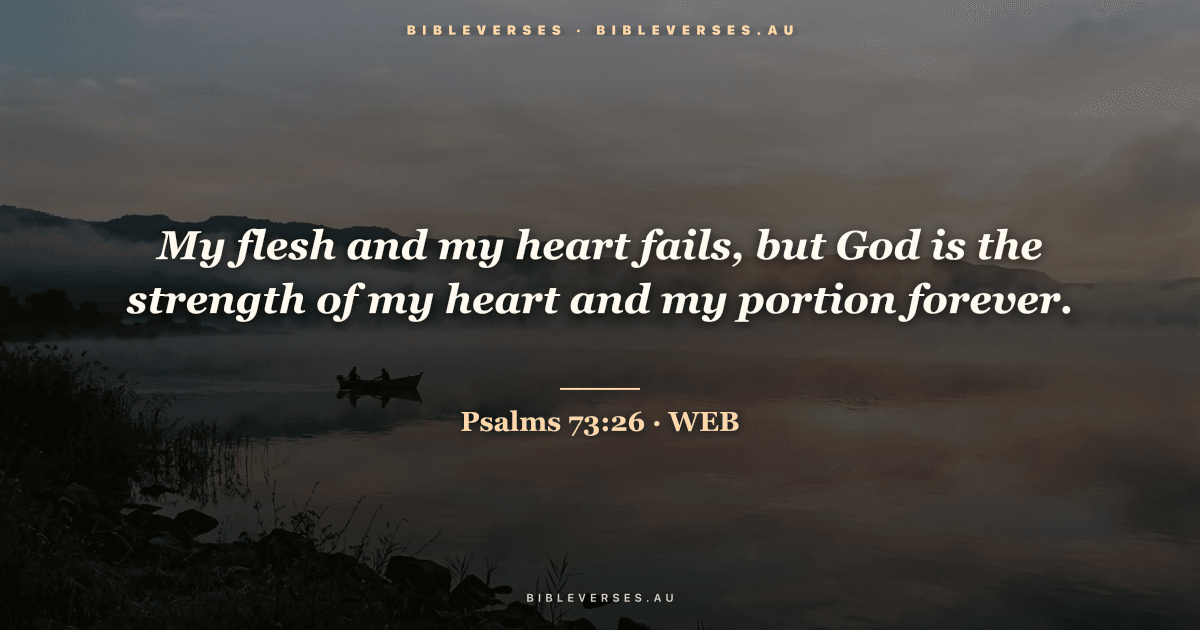
“My flesh and my heart fails, but God is the strength of my heart and my portion forever.”
KJV · King James Version
“My flesh7607 and my heart3824 faileth3615: but God430 is the strength6697 of my heart3824, and my portion2506 for ever5769. strength: Heb. rock”
Psalms 73:26-null · read in full chapter context →
1080 × 1080 · Square
Background
— or pick from our presets below —
Processed locally — your photo never leaves your device.
Every download includes a small bibleverses.au mark so others can find us too.
WEB vs KJV — how they differ
The WEB is a modern public-domain revision of the 1901 American Standard Version; the KJV dates to 1611. For Psalms 73:26, the KJV uses faileth, for, ever, heb, while the WEB renders these as fails, forever. Both translate the same underlying Greek or Hebrew text — the differences are stylistic, not theological.
In context
Psalms 73:26 in Psalms 73
A Bible verse rarely stands alone. Here is Psalms 73:26 read with the verses immediately before and after — the surrounding flow of Psalms 73. Read the full chapter →
- v.24 You will guide me with your counsel, and afterward receive me to glory.
- v.25 Whom do I have in heaven? There is no one on earth whom I desire besides you.
- v.26 My flesh and my heart fails, but God is the strength of my heart and my portion forever.
- v.27 For, behold, those who are far from you shall perish. You have destroyed all those who are unfaithful to you.
- v.28 But it is good for me to come close to God. I have made the Lord Yahweh my refuge, that I may tell of all your works.
Book background
About the Book of Psalms
- Testament
- Old Testament
- Genre
- Hebrew poetry
- Author
- David (73 psalms), Asaph, Sons of Korah, Solomon, Moses, others
- Date written
- c. 1410–430 BC (compiled over a millennium)
- Audience
- All of Israel's worshipping community — and the church
- Chapters
- 150
The Psalms are 150 inspired songs and prayers covering every emotion the human heart knows — praise, lament, confession, thanksgiving, anger, longing. About half are attributed to David. The book is divided into five "books," each ending with a doxology. The Psalms shape Christian prayer more than any other Old Testament book and are quoted in the New Testament more than any other.
Setting: 150 sacred songs used in temple worship; the Bible's songbook.
Key themes: worship · lament · trust · kingship · thanksgiving
Memorisation aid
How to memorise Psalms 73:26
Psalms 73:26 contains 18 words in 2 clauses. Learn one clause at a time, then chain them. The first-letter mnemonic (FLM) under each clause is a memory hook — once you can speak the FLM from memory, the full clause follows.
- 1
My flesh and my heart fails
MFAMHF
- 2
but God is the strength of my heart and my portion forever.
BGITSO
Frequently asked
FAQ about Psalms 73:26
What does Psalms 73:26 say?
Psalms 73:26 reads: "My flesh and my heart fails, but God is the strength of my heart and my portion forever." — from the Old Testament, Psalms (Hebrew poetry). The full verse is shown above with both the World English Bible (WEB) and King James Version (KJV) translations side by side.
What book of the Bible is Psalms 73:26 in?
Psalms 73:26 is in the book of Psalms, traditionally attributed to David (73 psalms), Asaph, Sons of Korah, Solomon, Moses, others and written around c. 1410–430 BC (compiled over a millennium). Psalms is hebrew poetry in the Old Testament, originally addressed to All of Israel's worshipping community — and the church. Best known for Psalm 23 ("The LORD is my shepherd") and Psalm 51.
What is Psalms 73:26 about?
Psalms 73:26 is primarily a Bible verse about Strength. Within Psalms, The Psalms are 150 inspired songs and prayers covering every emotion the human heart knows — praise, lament, confession, thanksgiving, anger, longing. Read the full passage above with surrounding context.
What is the difference between Psalms 73:26 in WEB and KJV?
Psalms 73:26 in the World English Bible (WEB) reads: "My flesh and my heart fails, but God is the strength of my heart and my portion forever.". The King James Version (KJV) reads: "My flesh7607 and my heart3824 faileth3615: but God430 is the strength6697 of my heart3824, and my portion2506 for ever5769. strength: Heb. rock". The WEB is a modern public-domain translation that updates the KJV's 1611 English while keeping a similar formal-equivalence style. Both render the same underlying Greek or Hebrew text.
How long is Psalms 73:26?
Psalms 73:26 is 18 words in the WEB translation (88 characters), broken into 2 clauses. It is short and well-suited to memorisation. Estimated reading time is about 5 seconds.
How can I memorise Psalms 73:26?
To memorise Psalms 73:26, split it into its 2 natural clauses and learn one at a time. Repeat the full verse out loud five times, then write it from memory. Saving the verse as a photo wallpaper using our verse image studio helps daily review — the visual association with a memorable background dramatically improves recall.
Why does Psalms 73:26 matter in Psalms?
The Psalms are 150 inspired songs and prayers covering every emotion the human heart knows — praise, lament, confession, thanksgiving, anger, longing. About half are attributed to David. The book is divided into five "books," each ending with a doxology. The Psalms shape Christian prayer more than any other Old Testament book and are quoted in the New Testament more than any other. Psalms 73:26 sits within this larger story — Psalms as a whole emphasises worship, lament, trust.
How can I apply Psalms 73:26 today?
Many readers use Psalms 73:26 as a daily reminder verse — saving it as a phone wallpaper, sharing it on Pinterest, or memorising it for prayer. The verse studio on this page lets you download Psalms 73:26 on 52 different backgrounds for free. Pair the verse with the surrounding chapter context shown above to understand its full meaning before applying it.
More designs
10 verses to read next
A fresh set of verses every visit — each on its own photo background. Tap any card to open the full study page.
-

Philippians 4:13
“I can do all things through Christ, who strengthens me.”
Read context →
-

Joshua 1:9
“Haven’t I commanded you? Be strong and courageous. Don’t be afraid. Don’t be dismayed, for Yahweh your God is with you wherever you go.””
Read context →
-

Isaiah 41:10
“Don’t you be afraid, for I am with you. Don’t be dismayed, for I am your God. I will strengthen you. Yes, I will help you. Yes, I will uphold you with the…”
Read context →
-
Isaiah 40:31
“But those who wait for Yahweh will renew their strength. They will mount up with wings like eagles. They will run, and not be weary. They will walk, and no…”
Read context →
-

Deuteronomy 31:6
“Be strong and courageous. Don’t be afraid or scared of them; for Yahweh your God himself is who goes with you. He will not fail you nor forsake you.””
Read context →
-

Psalms 27:1
“By David. Yahweh is my light and my salvation. Whom shall I fear? Yahweh is the strength of my life. Of whom shall I be afraid?”
Read context →
-
Psalms 46:1
“For the Chief Musician. By the sons of Korah. According to Alamoth. God is our refuge and strength, a very present help in trouble.”
Read context →
-
2 Corinthians 12:9
“He has said to me, "My grace is sufficient for you, for my power is made perfect in weakness." Most gladly therefore I will rather glory in my weaknesses,…”
Read context →
-

Psalm 46:1
“God is our refuge and strength, a very present help in trouble.”
Read context →
-

Deuteronomy 31:8
“Yahweh himself is who goes before you. He will be with you. He will not fail you nor forsake you. Don’t be afraid. Don’t be discouraged.””
Read context →
More featured verses in Psalms
Browse Psalms →
Psalms 23:1
“A Psalm by David. Yahweh is my shepherd: I shall lack nothing.”
Read context →
Psalm 23:1
“Yahweh is my shepherd: I shall lack nothing.”
Read context →

Psalms 23:4
“Even though I walk through the valley of the shadow of death, I will fear no evil, for you are with me. Your rod and your staff, they comfort me.”
Read context →
Psalms 27:1
“By David. Yahweh is my light and my salvation. Whom shall I fear? Yahweh is the strength of my life. Of whom shall I be afraid?”
Read context →