Proverbs · Chapter 28 · Forgiveness
Proverbs 28:13 — Bible Verse Meaning & Context
What has been forgiven, you can forgive.
Reviewed by the Bible Verses editorial team · World English Bible & King James Version (public domain)
Proverbs 28:13 — read it now
WEB · World English Bible
“He who conceals his sins doesn’t prosper, but whoever confesses and renounces them finds mercy.”
KJV · King James Version
“He that covereth3680 his sins6588 shall not prosper6743: but whoso confesseth3034 and forsaketh5800 them shall have mercy7355.”
Proverbs 28:13-null · read in full chapter context →
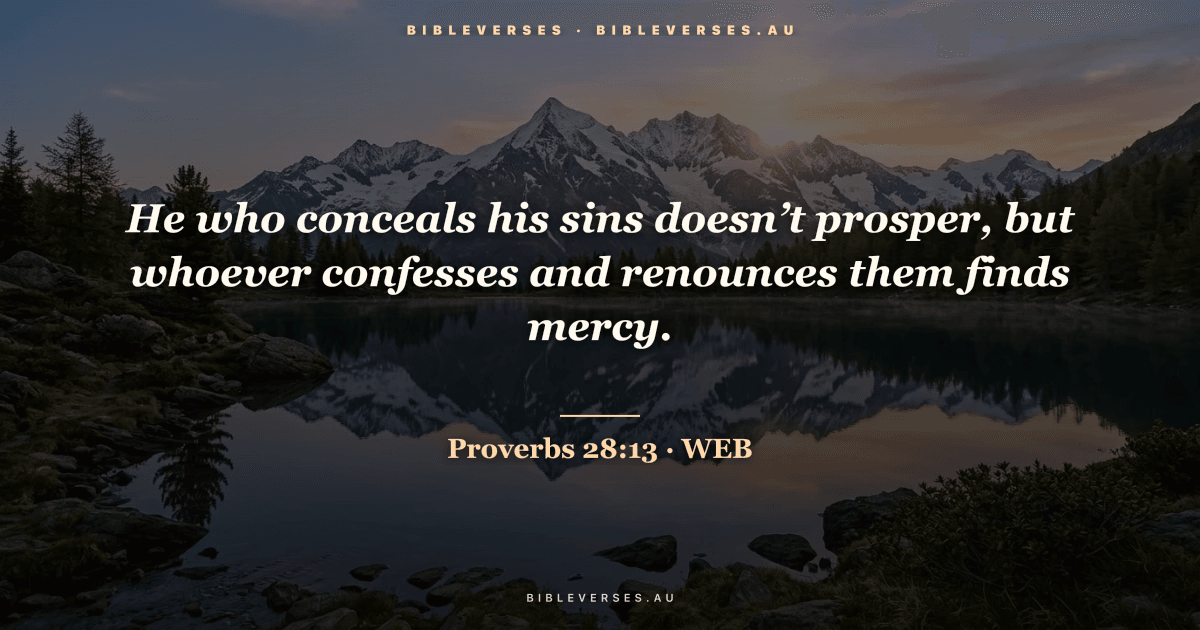
1080 × 1080 · Square
Background
— or pick from our presets below —
Processed locally — your photo never leaves your device.
Every download includes a small bibleverses.au mark so others can find us too.
WEB vs KJV — how they differ
The WEB is a modern public-domain revision of the 1901 American Standard Version; the KJV dates to 1611. For Proverbs 28:13, the KJV uses that, covereth, shall, not, while the WEB renders these as who, conceals, doesn, whoever. Both translate the same underlying Greek or Hebrew text — the differences are stylistic, not theological.
In context
Proverbs 28:13 in Proverbs 28
A Bible verse rarely stands alone. Here is Proverbs 28:13 read with the verses immediately before and after — the surrounding flow of Proverbs 28. Read the full chapter →
- v.11 The rich man is wise in his own eyes; but the poor who has understanding sees through him.
- v.12 When the righteous triumph, there is great glory; but when the wicked rise, men hide themselves.
- v.13 He who conceals his sins doesn’t prosper, but whoever confesses and renounces them finds mercy.
- v.14 Blessed is the man who always fears; but one who hardens his heart falls into trouble.
- v.15 As a roaring lion or a charging bear, so is a wicked ruler over helpless people.
Book background
About the Book of Proverbs
- Testament
- Old Testament
- Genre
- Wisdom literature
- Author
- Solomon (primarily), Agur, Lemuel
- Date written
- c. 970–700 BC
- Audience
- Young men learning the wisdom of the covenant
- Chapters
- 31
Proverbs offers practical, observable wisdom for living under God in the everyday world — speech, money, marriage, friendship, work, anger. Its core thesis is in 1:7: "The fear of the LORD is the beginning of knowledge." Chapter 31 closes with the famous portrait of the wise woman whose worth is "far above rubies."
Setting: Compiled across multiple reigns; Solomon's collection plus later additions.
Key themes: wisdom · fear of the LORD · speech · work · relationships
Memorisation aid
How to memorise Proverbs 28:13
Proverbs 28:13 contains 15 words in 2 clauses. Learn one clause at a time, then chain them. The first-letter mnemonic (FLM) under each clause is a memory hook — once you can speak the FLM from memory, the full clause follows.
- 1
He who conceals his sins doesn’t prosper
HWCHSD
- 2
but whoever confesses and renounces them finds mercy.
BWCART
Frequently asked
FAQ about Proverbs 28:13
What does Proverbs 28:13 say?
Proverbs 28:13 reads: "He who conceals his sins doesn’t prosper, but whoever confesses and renounces them finds mercy." — from the Old Testament, Proverbs (Wisdom literature). The full verse is shown above with both the World English Bible (WEB) and King James Version (KJV) translations side by side.
What book of the Bible is Proverbs 28:13 in?
Proverbs 28:13 is in the book of Proverbs, traditionally attributed to Solomon (primarily), Agur, Lemuel and written around c. 970–700 BC. Proverbs is wisdom literature in the Old Testament, originally addressed to Young men learning the wisdom of the covenant. Best known for "trust in the LORD with all your heart" (3:5-6).
What is Proverbs 28:13 about?
Proverbs 28:13 is primarily a Bible verse about Forgiveness. Within Proverbs, Proverbs offers practical, observable wisdom for living under God in the everyday world — speech, money, marriage, friendship, work, anger. Read the full passage above with surrounding context.
What is the difference between Proverbs 28:13 in WEB and KJV?
Proverbs 28:13 in the World English Bible (WEB) reads: "He who conceals his sins doesn’t prosper, but whoever confesses and renounces them finds mercy.". The King James Version (KJV) reads: "He that covereth3680 his sins6588 shall not prosper6743: but whoso confesseth3034 and forsaketh5800 them shall have mercy7355.". The WEB is a modern public-domain translation that updates the KJV's 1611 English while keeping a similar formal-equivalence style. Both render the same underlying Greek or Hebrew text.
How long is Proverbs 28:13?
Proverbs 28:13 is 15 words in the WEB translation (95 characters), broken into 2 clauses. It is short and well-suited to memorisation. Estimated reading time is about 5 seconds.
How can I memorise Proverbs 28:13?
To memorise Proverbs 28:13, split it into its 2 natural clauses and learn one at a time. Repeat the full verse out loud five times, then write it from memory. Saving the verse as a photo wallpaper using our verse image studio helps daily review — the visual association with a memorable background dramatically improves recall.
Why does Proverbs 28:13 matter in Proverbs?
Proverbs offers practical, observable wisdom for living under God in the everyday world — speech, money, marriage, friendship, work, anger. Its core thesis is in 1:7: "The fear of the LORD is the beginning of knowledge." Chapter 31 closes with the famous portrait of the wise woman whose worth is "far above rubies." Proverbs 28:13 sits within this larger story — Proverbs as a whole emphasises wisdom, fear of the LORD, speech.
How can I apply Proverbs 28:13 today?
Many readers use Proverbs 28:13 as a daily reminder verse — saving it as a phone wallpaper, sharing it on Pinterest, or memorising it for prayer. The verse studio on this page lets you download Proverbs 28:13 on 52 different backgrounds for free. Pair the verse with the surrounding chapter context shown above to understand its full meaning before applying it.
More designs
10 verses to read next
A fresh set of verses every visit — each on its own photo background. Tap any card to open the full study page.
-

Romans 5:8
“But God commends his own love toward us, in that while we were yet sinners, Christ died for us.”
Read context →
-

1 John 1:9
“If we confess our sins, he is faithful and righteous to forgive us the sins, and to cleanse us from all unrighteousness.”
Read context →
-

Ephesians 4:32
“And be kind to one another, tender hearted, forgiving each other, just as God also in Christ forgave you.”
Read context →
-

2 Chronicles 7:14
“if my people, who are called by my name, will humble themselves, pray, seek my face, and turn from their wicked ways; then I will hear from heaven, will fo…”
Read context →
-

Matthew 5:44
“But I tell you, love your enemies, bless those who curse you, do good to those who hate you, and pray for those who mistreat you and persecute you,”
Read context →
-

James 5:16
“Confess your offenses to one another, and pray for one another, that you may be healed. The insistent prayer of a righteous person is powerfully effective.”
Read context →
-

1 Peter 4:8
“And above all things be earnest in your love among yourselves, for love covers a multitude of sins.”
Read context →
-

Matthew 6:14
“For if you forgive men their trespasses, your heavenly Father will also forgive you.”
Read context →
-
Psalms 51:10
“Create in me a clean heart, O God. Renew a right spirit within me.”
Read context →
-
Psalms 103:12
“As far as the east is from the west, so far has he removed our transgressions from us.”
Read context →
More featured verses in Proverbs
Browse Proverbs →
Proverbs 3:5-6
“Trust in Yahweh with all your heart, and don't lean on your own understanding. In all your ways acknowledge him, and he will make your paths straight.”
Read context →

Proverbs 3:6
“In all your ways acknowledge him, and he will make your paths straight.”
Read context →

Proverbs 17:17
“A friend loves at all times; and a brother is born for adversity.”
Read context →
Proverbs 22:6
“Train up a child in the way he should go, and when he is old he will not depart from it.”
Read context →