Hosea · Chapter 6 · Healing
Hosea 6:1 — Bible Verse Meaning & Context
For the wound that has not yet closed.
Reviewed by the Bible Verses editorial team · World English Bible & King James Version (public domain)
Hosea 6:1 — read it now
WEB · World English Bible
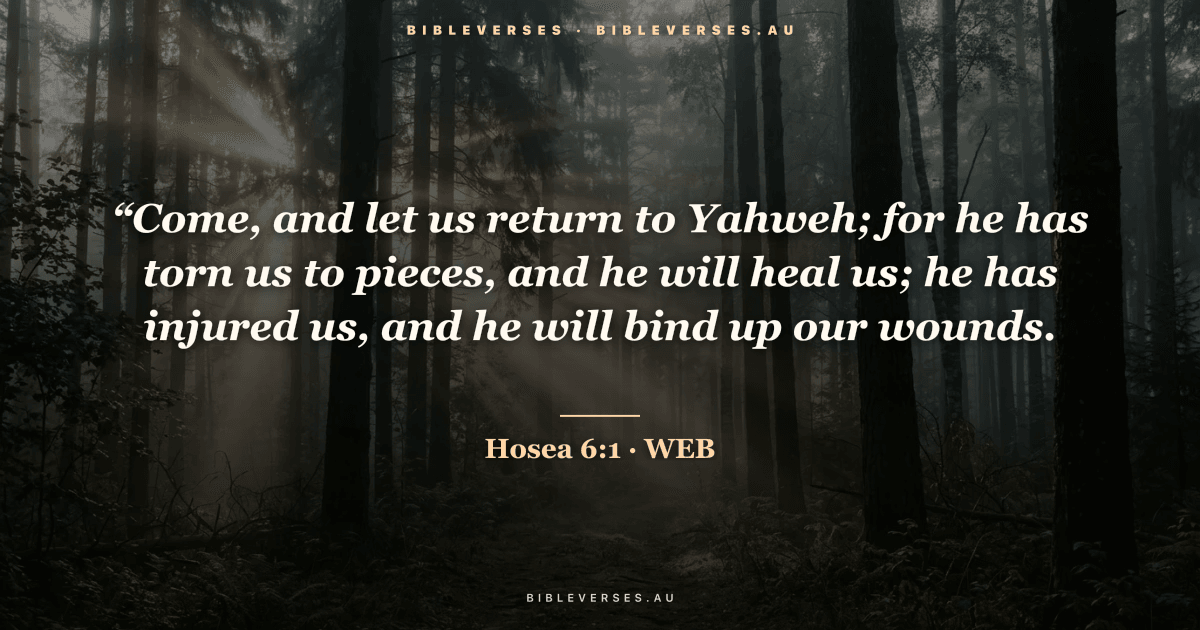
““Come, and let us return to Yahweh; for he has torn us to pieces, and he will heal us; he has injured us, and he will bind up our wounds.”
KJV · King James Version
“Come3212, and let us return7725 unto the LORD3068: for he hath torn2963, and he will heal7495 us; he hath smitten5221, and he will bind us up2280.”
Hosea 6:1-null · read in full chapter context →
1080 × 1080 · Square
Background
— or pick from our presets below —
Processed locally — your photo never leaves your device.
Every download includes a small bibleverses.au mark so others can find us too.
WEB vs KJV — how they differ
The WEB is a modern public-domain revision of the 1901 American Standard Version; the KJV dates to 1611. For Hosea 6:1, the KJV uses unto, the, lord, hath, while the WEB renders these as yahweh, has, pieces, injured. Both translate the same underlying Greek or Hebrew text — the differences are stylistic, not theological.
In context
Hosea 6:1 in Hosea 6
A Bible verse rarely stands alone. Here is Hosea 6:1 read with the verses immediately before and after — the surrounding flow of Hosea 6. Read the full chapter →
- v.1 “Come, and let us return to Yahweh; for he has torn us to pieces, and he will heal us; he has injured us, and he will bind up our wounds.
- v.2 After two days he will revive us. On the third day he will raise us up, and we will live before him.
- v.3 Let us acknowledge Yahweh. Let us press on to know Yahweh. As surely as the sun rises, Yahweh will appear. He will come to us like the rain, like the spring rain that waters the earth.”
Book background
About the Book of Hosea
- Testament
- Old Testament
- Genre
- Minor prophet
- Author
- Hosea
- Date written
- c. 755–710 BC
- Audience
- The northern kingdom of Israel
- Chapters
- 14
God commanded Hosea to marry Gomer, an unfaithful woman, as a living picture of Israel's spiritual adultery. Despite repeated betrayal, Hosea kept loving and redeeming her — illustrating God's relentless covenant love for a faithless people. The book's declaration "I desire steadfast love and not sacrifice" (6:6) was quoted by Jesus.
Setting: Northern Israel in the decades before its fall to Assyria (722 BC).
Key themes: covenant love · unfaithfulness · judgment · restoration · mercy
Memorisation aid
How to memorise Hosea 6:1
Hosea 6:1 contains 30 words in 6 clauses. Learn one clause at a time, then chain them. The first-letter mnemonic (FLM) under each clause is a memory hook — once you can speak the FLM from memory, the full clause follows.
- 1
“Come
C
- 2
and let us return to Yahweh
ALURTY
- 3
for he has torn us to pieces
FHHTUT
- 4
and he will heal us
AHWHU
- 5
he has injured us
HHIU
- 6
and he will bind up our wounds.
AHWBUO
Frequently asked
FAQ about Hosea 6:1
What does Hosea 6:1 say?
Hosea 6:1 reads: "“Come, and let us return to Yahweh; for he has torn us to pieces, and he will heal us; he has injured us, and he will bind up our wounds." — from the Old Testament, Hosea (Minor prophet). The full verse is shown above with both the World English Bible (WEB) and King James Version (KJV) translations side by side.
What book of the Bible is Hosea 6:1 in?
Hosea 6:1 is in the book of Hosea, traditionally attributed to Hosea and written around c. 755–710 BC. Hosea is minor prophet in the Old Testament, originally addressed to The northern kingdom of Israel. Best known for Hosea's marriage as a picture of God's love.
What is Hosea 6:1 about?
Hosea 6:1 is primarily a Bible verse about Healing. Within Hosea, God commanded Hosea to marry Gomer, an unfaithful woman, as a living picture of Israel's spiritual adultery. Read the full passage above with surrounding context.
What is the difference between Hosea 6:1 in WEB and KJV?
Hosea 6:1 in the World English Bible (WEB) reads: "“Come, and let us return to Yahweh; for he has torn us to pieces, and he will heal us; he has injured us, and he will bind up our wounds.". The King James Version (KJV) reads: "Come3212, and let us return7725 unto the LORD3068: for he hath torn2963, and he will heal7495 us; he hath smitten5221, and he will bind us up2280.". The WEB is a modern public-domain translation that updates the KJV's 1611 English while keeping a similar formal-equivalence style. Both render the same underlying Greek or Hebrew text.
How long is Hosea 6:1?
Hosea 6:1 is 30 words in the WEB translation (137 characters), broken into 6 clauses. It is a longer verse, often broken into smaller phrases for memorisation. Estimated reading time is about 9 seconds.
How can I memorise Hosea 6:1?
To memorise Hosea 6:1, split it into its 6 natural clauses and learn one at a time. Repeat the full verse out loud five times, then write it from memory. Saving the verse as a photo wallpaper using our verse image studio helps daily review — the visual association with a memorable background dramatically improves recall.
Why does Hosea 6:1 matter in Hosea?
God commanded Hosea to marry Gomer, an unfaithful woman, as a living picture of Israel's spiritual adultery. Despite repeated betrayal, Hosea kept loving and redeeming her — illustrating God's relentless covenant love for a faithless people. The book's declaration "I desire steadfast love and not sacrifice" (6:6) was quoted by Jesus. Hosea 6:1 sits within this larger story — Hosea as a whole emphasises covenant love, unfaithfulness, judgment.
How can I apply Hosea 6:1 today?
Many readers use Hosea 6:1 as a daily reminder verse — saving it as a phone wallpaper, sharing it on Pinterest, or memorising it for prayer. The verse studio on this page lets you download Hosea 6:1 on 52 different backgrounds for free. Pair the verse with the surrounding chapter context shown above to understand its full meaning before applying it.
More designs
10 verses to read next
A fresh set of verses every visit — each on its own photo background. Tap any card to open the full study page.
-

Matthew 11:28
““Come to me, all you who labor and are heavily burdened, and I will give you rest.”
Read context →
-
2 Corinthians 12:9
“He has said to me, "My grace is sufficient for you, for my power is made perfect in weakness." Most gladly therefore I will rather glory in my weaknesses,…”
Read context →
-

Psalm 147:3
“He heals the broken in heart, and binds up their wounds.”
Read context →
-

Psalms 34:18
“Yahweh is near to those who have a broken heart, and saves those who have a crushed spirit.”
Read context →
-

Psalms 147:3
“He heals the broken in heart, and binds up their wounds.”
Read context →
-
Isaiah 53:5
“But he was pierced for our transgressions. He was crushed for our iniquities. The punishment that brought our peace was on him; and by his wounds we are healed.”
Read context →
-

James 5:16
“Confess your offenses to one another, and pray for one another, that you may be healed. The insistent prayer of a righteous person is powerfully effective.”
Read context →
-

Revelation 21:4
“He will wipe away from them every tear from their eyes. Death will be no more; neither will there be mourning, nor crying, nor pain, any more. The first th…”
Read context →
-

James 5:14-15
“Is any among you sick? Let him call for the elders of the assembly, and let them pray over him, anointing him with oil in the name of the Lord, and the pra…”
Read context →
-

Jeremiah 17:14
“Heal me, O Yahweh, and I shall be healed. Save me, and I shall be saved; for you are my praise.”
Read context →
More featured verses in Hosea
Browse Hosea →