2 Kings · Chapter 6 · Strength
2 Kings 6:16 — Bible Verse Meaning & Context
For the day that asks more than you feel ready to give.
Reviewed by the Bible Verses editorial team · World English Bible & King James Version (public domain)
2 Kings 6:16 — read it now
WEB · World English Bible
“He answered, “Don’t be afraid; for those who are with us are more than those who are with them.””
KJV · King James Version
“And he answered559, Fear3372 not: for they that be with us are more7227 than they that be with them.”
2 Kings 6:16-null · read in full chapter context →
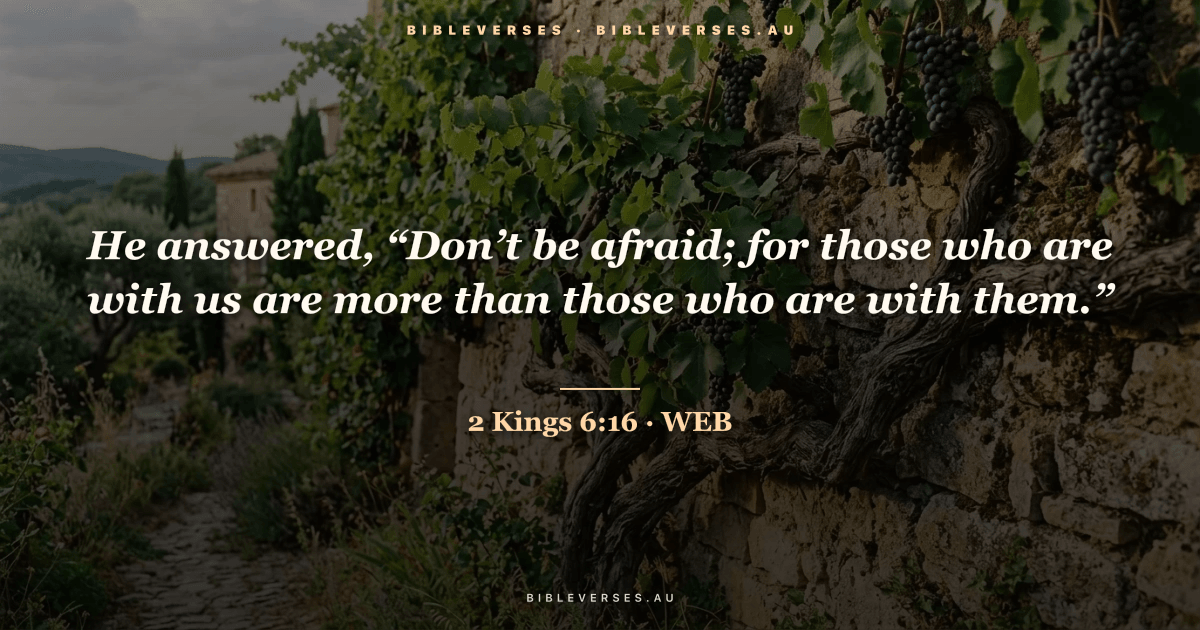
1080 × 1080 · Square
Background
— or pick from our presets below —
Processed locally — your photo never leaves your device.
Every download includes a small bibleverses.au mark so others can find us too.
WEB vs KJV — how they differ
The WEB is a modern public-domain revision of the 1901 American Standard Version; the KJV dates to 1611. For 2 Kings 6:16, the KJV uses and, fear, not, they, while the WEB renders these as don, afraid, those, who. Both translate the same underlying Greek or Hebrew text — the differences are stylistic, not theological.
In context
2 Kings 6:16 in 2 Kings 6
A Bible verse rarely stands alone. Here is 2 Kings 6:16 read with the verses immediately before and after — the surrounding flow of 2 Kings 6. Read the full chapter →
- v.14 Therefore he sent horses, chariots, and a great army there. They came by night, and surrounded the city.
- v.15 When the servant of the man of God had risen early, and gone out, behold, an army with horses and chariots was around the city. His servant said to him, “Alas, my master! What shall we do?”
- v.16 He answered, “Don’t be afraid; for those who are with us are more than those who are with them.”
- v.17 Elisha prayed, and said, “Yahweh, please open his eyes, that he may see.” Yahweh opened the young man’s eyes; and he saw: and behold, the mountain was full of horses and chariots of fire around Elisha.
- v.18 When they came down to him, Elisha prayed to Yahweh, and said, “Please strike this people with blindness.” He struck them with blindness according to Elishah’s word.
Book background
About the Book of 2 Kings
- Testament
- Old Testament
- Genre
- Historical narrative
- Author
- Unknown (traditionally Jeremiah)
- Date written
- c. 561–538 BC
- Audience
- Jews in Babylonian exile
- Chapters
- 25
2 Kings continues Elijah and Elisha's ministry then traces the decline of both kingdoms. The northern kingdom fell to Assyria in 722 BC; Judah survived under reformers like Hezekiah and Josiah but was finally destroyed by Babylon in 586 BC. The book ends with a glimmer of hope — Jehoiachin released in exile.
Setting: From Elijah's ascent through the fall of Samaria (722 BC) and Jerusalem (586 BC).
Key themes: judgment · exile · prophecy · covenant unfaithfulness · remnant
Memorisation aid
How to memorise 2 Kings 6:16
2 Kings 6:16 contains 19 words in 3 clauses. Learn one clause at a time, then chain them. The first-letter mnemonic (FLM) under each clause is a memory hook — once you can speak the FLM from memory, the full clause follows.
- 1
He answered
HA
- 2
“Don’t be afraid
DBA
- 3
for those who are with us are more than those who are with them.”
FTWAWU
Frequently asked
FAQ about 2 Kings 6:16
What does 2 Kings 6:16 say?
2 Kings 6:16 reads: "He answered, “Don’t be afraid; for those who are with us are more than those who are with them.”" — from the Old Testament, 2 Kings (Historical narrative). The full verse is shown above with both the World English Bible (WEB) and King James Version (KJV) translations side by side.
What book of the Bible is 2 Kings 6:16 in?
2 Kings 6:16 is in the book of 2 Kings, traditionally attributed to Unknown (traditionally Jeremiah) and written around c. 561–538 BC. 2 Kings is historical narrative in the Old Testament, originally addressed to Jews in Babylonian exile. Best known for the fall of Jerusalem and the exile to Babylon.
What is 2 Kings 6:16 about?
2 Kings 6:16 is primarily a Bible verse about Strength, with related themes including Anxiety. Within 2 Kings, 2 Kings continues Elijah and Elisha's ministry then traces the decline of both kingdoms. Read the full passage above with surrounding context.
What is the difference between 2 Kings 6:16 in WEB and KJV?
2 Kings 6:16 in the World English Bible (WEB) reads: "He answered, “Don’t be afraid; for those who are with us are more than those who are with them.”". The King James Version (KJV) reads: "And he answered559, Fear3372 not: for they that be with us are more7227 than they that be with them.". The WEB is a modern public-domain translation that updates the KJV's 1611 English while keeping a similar formal-equivalence style. Both render the same underlying Greek or Hebrew text.
How long is 2 Kings 6:16?
2 Kings 6:16 is 19 words in the WEB translation (96 characters), broken into 3 clauses. It is short and well-suited to memorisation. Estimated reading time is about 6 seconds.
How can I memorise 2 Kings 6:16?
To memorise 2 Kings 6:16, split it into its 3 natural clauses and learn one at a time. Repeat the full verse out loud five times, then write it from memory. Saving the verse as a photo wallpaper using our verse image studio helps daily review — the visual association with a memorable background dramatically improves recall.
Why does 2 Kings 6:16 matter in 2 Kings?
2 Kings continues Elijah and Elisha's ministry then traces the decline of both kingdoms. The northern kingdom fell to Assyria in 722 BC; Judah survived under reformers like Hezekiah and Josiah but was finally destroyed by Babylon in 586 BC. The book ends with a glimmer of hope — Jehoiachin released in exile. 2 Kings 6:16 sits within this larger story — 2 Kings as a whole emphasises judgment, exile, prophecy.
How can I apply 2 Kings 6:16 today?
Many readers use 2 Kings 6:16 as a daily reminder verse — saving it as a phone wallpaper, sharing it on Pinterest, or memorising it for prayer. The verse studio on this page lets you download 2 Kings 6:16 on 52 different backgrounds for free. Pair the verse with the surrounding chapter context shown above to understand its full meaning before applying it.
More designs
10 verses to read next
A fresh set of verses every visit — each on its own photo background. Tap any card to open the full study page.
-

Philippians 4:13
“I can do all things through Christ, who strengthens me.”
Read context →
-

Joshua 1:9
“Haven’t I commanded you? Be strong and courageous. Don’t be afraid. Don’t be dismayed, for Yahweh your God is with you wherever you go.””
Read context →
-

Isaiah 41:10
“Don’t you be afraid, for I am with you. Don’t be dismayed, for I am your God. I will strengthen you. Yes, I will help you. Yes, I will uphold you with the…”
Read context →
-

Isaiah 40:31
“But those who wait for Yahweh will renew their strength. They will mount up with wings like eagles. They will run, and not be weary. They will walk, and no…”
Read context →
-

Deuteronomy 31:6
“Be strong and courageous. Don’t be afraid or scared of them; for Yahweh your God himself is who goes with you. He will not fail you nor forsake you.””
Read context →
-

Psalms 27:1
“By David. Yahweh is my light and my salvation. Whom shall I fear? Yahweh is the strength of my life. Of whom shall I be afraid?”
Read context →
-
Psalms 46:1
“For the Chief Musician. By the sons of Korah. According to Alamoth. God is our refuge and strength, a very present help in trouble.”
Read context →
-
2 Corinthians 12:9
“He has said to me, "My grace is sufficient for you, for my power is made perfect in weakness." Most gladly therefore I will rather glory in my weaknesses,…”
Read context →
-

Psalm 46:1
“God is our refuge and strength, a very present help in trouble.”
Read context →
-

Deuteronomy 31:8
“Yahweh himself is who goes before you. He will be with you. He will not fail you nor forsake you. Don’t be afraid. Don’t be discouraged.””
Read context →