Job · Chapter 1 · Gratitude
Job 1:21 — Bible Verse Meaning & Context
Read this verse slowly. Let it settle before you move on.
Reviewed by the Bible Verses editorial team · World English Bible & King James Version (public domain)
Job 1:21 — read it now
WEB · World English Bible
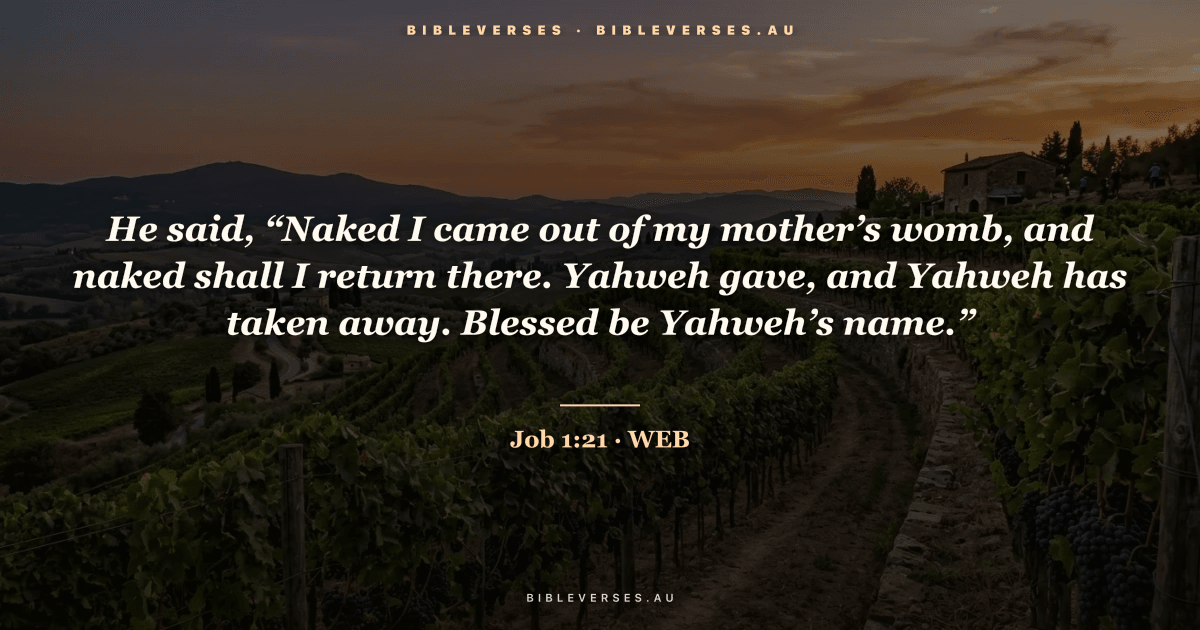
“He said, “Naked I came out of my mother’s womb, and naked shall I return there. Yahweh gave, and Yahweh has taken away. Blessed be Yahweh’s name.””
KJV · King James Version
“And said559, Naked6174 came I out3318 of my mother's517 womb990, and naked6174 shall I return7725 thither: the LORD3068 gave5414, and the LORD3068 hath taken away3947; blessed1288 be the name8034 of the LORD3068.”
Job 1:21-null · read in full chapter context →
1080 × 1080 · Square
Background
— or pick from our presets below —
Processed locally — your photo never leaves your device.
Every download includes a small bibleverses.au mark so others can find us too.
WEB vs KJV — how they differ
The WEB is a modern public-domain revision of the 1901 American Standard Version; the KJV dates to 1611. For Job 1:21, the KJV uses mother's, thither, the, lord, while the WEB renders these as mother, there, yahweh, has. Both translate the same underlying Greek or Hebrew text — the differences are stylistic, not theological.
In context
Job 1:21 in Job 1
A Bible verse rarely stands alone. Here is Job 1:21 read with the verses immediately before and after — the surrounding flow of Job 1. Read the full chapter →
- v.19 and behold, there came a great wind from the wilderness, and struck the four corners of the house, and it fell on the young men, and they are dead. I alone have escaped to tell you.”
- v.20 Then Job arose, and tore his robe, and shaved his head, and fell down on the ground, and worshiped.
- v.21 He said, “Naked I came out of my mother’s womb, and naked shall I return there. Yahweh gave, and Yahweh has taken away. Blessed be Yahweh’s name.”
- v.22 In all this, Job did not sin, nor charge God with wrongdoing.
Book background
About the Book of Job
- Testament
- Old Testament
- Genre
- Wisdom literature
- Author
- Unknown
- Date written
- Possibly patriarchal era (c. 2000 BC); written down later
- Audience
- Ancient Israel
- Chapters
- 42
Job, "blameless and upright," loses his children, wealth, and health in a heavenly contest he never sees. His three friends insist his suffering must be punishment for sin; Job protests his innocence and demands an audience with God. When God finally speaks from the whirlwind, He does not answer the "why" but reveals Himself — and Job is satisfied. The book reframes how Christians read suffering.
Setting: The land of Uz; Job's story sits outside Israel's national history.
Key themes: suffering · God's sovereignty · integrity · mystery · restoration
Memorisation aid
How to memorise Job 1:21
Job 1:21 contains 27 words in 6 clauses. Learn one clause at a time, then chain them. The first-letter mnemonic (FLM) under each clause is a memory hook — once you can speak the FLM from memory, the full clause follows.
- 1
He said
HS
- 2
“Naked I came out of my mother’s womb
NICOOM
- 3
and naked shall I return there
ANSIRT
- 4
Yahweh gave
YG
- 5
and Yahweh has taken away
AYHTA
- 6
Blessed be Yahweh’s name.”
BBYN
Frequently asked
FAQ about Job 1:21
What does Job 1:21 say?
Job 1:21 reads: "He said, “Naked I came out of my mother’s womb, and naked shall I return there. Yahweh gave, and Yahweh has taken away. Blessed be Yahweh’s name.”" — from the Old Testament, Job (Wisdom literature). The full verse is shown above with both the World English Bible (WEB) and King James Version (KJV) translations side by side.
What book of the Bible is Job 1:21 in?
Job 1:21 is in the book of Job, traditionally attributed to Unknown and written around Possibly patriarchal era (c. 2000 BC); written down later. Job is wisdom literature in the Old Testament, originally addressed to Ancient Israel. Best known for "the LORD gave, and the LORD has taken away; blessed be the name of the LORD".
What is Job 1:21 about?
Job 1:21 is primarily a Bible verse about Gratitude, with related themes including Grief. Within Job, Job, "blameless and upright," loses his children, wealth, and health in a heavenly contest he never sees. Read the full passage above with surrounding context.
What is the difference between Job 1:21 in WEB and KJV?
Job 1:21 in the World English Bible (WEB) reads: "He said, “Naked I came out of my mother’s womb, and naked shall I return there. Yahweh gave, and Yahweh has taken away. Blessed be Yahweh’s name.”". The King James Version (KJV) reads: "And said559, Naked6174 came I out3318 of my mother's517 womb990, and naked6174 shall I return7725 thither: the LORD3068 gave5414, and the LORD3068 hath taken away3947; blessed1288 be the name8034 of the LORD3068.". The WEB is a modern public-domain translation that updates the KJV's 1611 English while keeping a similar formal-equivalence style. Both render the same underlying Greek or Hebrew text.
How long is Job 1:21?
Job 1:21 is 27 words in the WEB translation (146 characters), broken into 6 clauses. It is a longer verse, often broken into smaller phrases for memorisation. Estimated reading time is about 8 seconds.
How can I memorise Job 1:21?
To memorise Job 1:21, split it into its 6 natural clauses and learn one at a time. Repeat the full verse out loud five times, then write it from memory. Saving the verse as a photo wallpaper using our verse image studio helps daily review — the visual association with a memorable background dramatically improves recall.
Why does Job 1:21 matter in Job?
Job, "blameless and upright," loses his children, wealth, and health in a heavenly contest he never sees. His three friends insist his suffering must be punishment for sin; Job protests his innocence and demands an audience with God. When God finally speaks from the whirlwind, He does not answer the "why" but reveals Himself — and Job is satisfied. The book reframes how Christians read suffering. Job 1:21 sits within this larger story — Job as a whole emphasises suffering, God's sovereignty, integrity.
How can I apply Job 1:21 today?
Many readers use Job 1:21 as a daily reminder verse — saving it as a phone wallpaper, sharing it on Pinterest, or memorising it for prayer. The verse studio on this page lets you download Job 1:21 on 52 different backgrounds for free. Pair the verse with the surrounding chapter context shown above to understand its full meaning before applying it.
More designs
10 verses to read next
A fresh set of verses every visit — each on its own photo background. Tap any card to open the full study page.
-

Psalms 118:24
“This is the day that Yahweh has made. We will rejoice and be glad in it!”
Read context →
-

Psalms 100:4
“Enter into his gates with thanksgiving, into his courts with praise. Give thanks to him, and bless his name.”
Read context →
-

Philippians 4:4
“Rejoice in the Lord always! Again I will say, “Rejoice!””
Read context →
-

1 Thessalonians 5:18
“In everything give thanks, for this is the will of God in Christ Jesus toward you.”
Read context →
-

James 1:17
“Every good gift and every perfect gift is from above, coming down from the Father of lights, with whom can be no variation, nor turning shadow.”
Read context →
-

1 Chronicles 16:34
“Oh give thanks to Yahweh, for he is good, for his loving kindness endures forever.”
Read context →
-

Nehemiah 8:10
“Then he said to them, “Go your way. Eat the fat, drink the sweet, and send portions to him for whom nothing is prepared, for today is holy to our Lord. Don…”
Read context →
-

Malachi 3:10
“Bring the whole tithe into the storehouse, that there may be food in my house, and test me now in this,” says Yahweh of Armies, “if I will not open you the…”
Read context →
-
Luke 6:38
““Give, and it will be given to you: good measure, pressed down, shaken together, and running over, will be given to you. For with the same measure you meas…”
Read context →
-

1 Corinthians 15:57
“But thanks be to God, who gives us the victory through our Lord Jesus Christ.”
Read context →
More featured verses in Job
Browse Job →
Job 19:25
“But as for me, I know that my Redeemer lives. In the end, he will stand upon the earth.”
Read context →

Job 23:10
“But he knows the way that I take. When he has tried me, I shall come out like gold.”
Read context →

Job 42:2
““I know that you can do all things, and that no purpose of yours can be restrained.”
Read context →

Job 5:17
““Behold, happy is the man whom God corrects. Therefore do not despise the chastening of the Almighty.”
Read context →