1 Timothy · Chapter 2 · Prayer
1 Timothy 2:1 — Bible Verse Meaning & Context
Read this verse slowly. Let it settle before you move on.
Reviewed by the Bible Verses editorial team · World English Bible & King James Version (public domain)
1 Timothy 2:1 — read it now
WEB · World English Bible
“I exhort therefore, first of all, that petitions, prayers, intercessions, and givings of thanks, be made for all men:”
KJV · King James Version
“I exhort3870 therefore3767, that, first4412 of all3956, supplications1162, prayers4335, intercessions1783, and giving of thanks2169, be made4160 for5228 all3956 men444; exhort: or, desire”
1 Timothy 2:1-null · read in full chapter context →
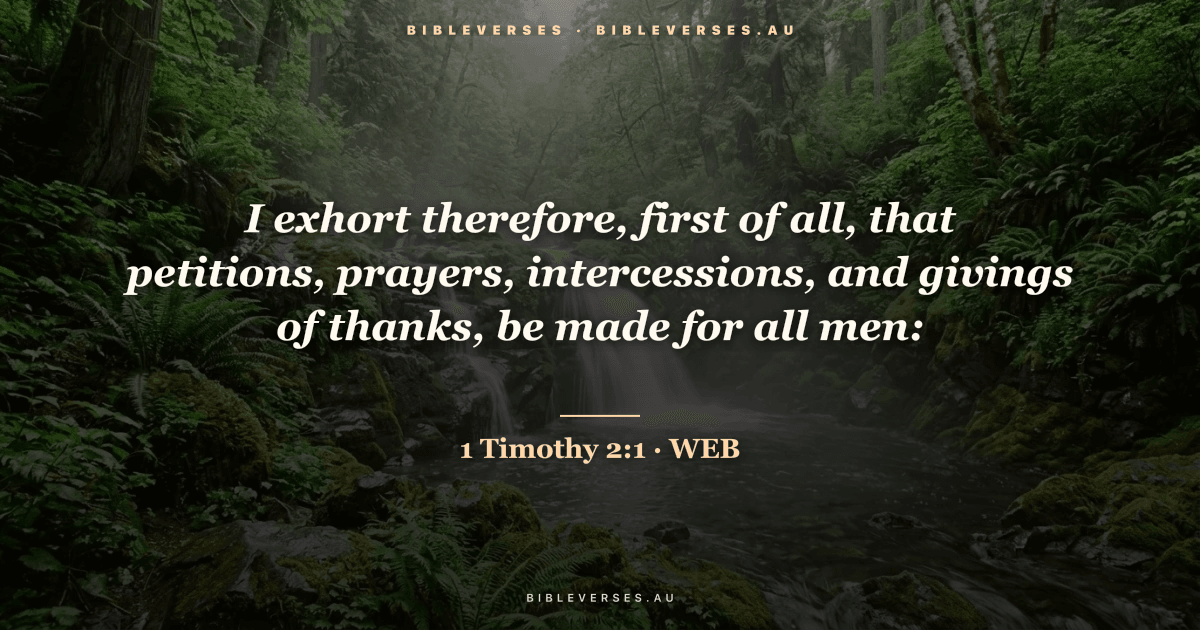
1080 × 1080 · Square
Background
— or pick from our presets below —
Processed locally — your photo never leaves your device.
Every download includes a small bibleverses.au mark so others can find us too.
WEB vs KJV — how they differ
The WEB is a modern public-domain revision of the 1901 American Standard Version; the KJV dates to 1611. For 1 Timothy 2:1, the KJV uses supplications, giving, desire, while the WEB renders these as petitions, givings. Both translate the same underlying Greek or Hebrew text — the differences are stylistic, not theological.
In context
1 Timothy 2:1 in 1 Timothy 2
A Bible verse rarely stands alone. Here is 1 Timothy 2:1 read with the verses immediately before and after — the surrounding flow of 1 Timothy 2. Read the full chapter →
- v.1 I exhort therefore, first of all, that petitions, prayers, intercessions, and givings of thanks, be made for all men:
- v.2 for kings and all who are in high places; that we may lead a tranquil and quiet life in all godliness and reverence.
- v.3 For this is good and acceptable in the sight of God our Savior;
Book background
About the Book of 1 Timothy
- Testament
- New Testament
- Genre
- Pauline epistle
- Author
- Paul
- Date written
- c. 62–64 AD
- Audience
- Timothy, Paul's young protégé pastoring at Ephesus
- Chapters
- 6
1 Timothy is a pastoral handbook — instructions on confronting false teaching, qualifications for elders and deacons, the conduct of public worship, the care of widows, and personal holiness for a young pastor. Its declaration that "godliness with contentment is great gain" (6:6) defines Paul's spiritual economy.
Setting: A pastoral letter on leading a healthy church.
Key themes: leadership · sound doctrine · worship · church order · godliness
Memorisation aid
How to memorise 1 Timothy 2:1
1 Timothy 2:1 contains 19 words in 7 clauses. Learn one clause at a time, then chain them. The first-letter mnemonic (FLM) under each clause is a memory hook — once you can speak the FLM from memory, the full clause follows.
- 1
I exhort therefore
IET
- 2
first of all
FOA
- 3
that petitions
TP
- 4
prayers
P
- 5
intercessions
I
- 6
and givings of thanks
AGOT
- 7
be made for all men:
BMFAM
Frequently asked
FAQ about 1 Timothy 2:1
What does 1 Timothy 2:1 say?
1 Timothy 2:1 reads: "I exhort therefore, first of all, that petitions, prayers, intercessions, and givings of thanks, be made for all men:" — from the New Testament, 1 Timothy (Pauline epistle). The full verse is shown above with both the World English Bible (WEB) and King James Version (KJV) translations side by side.
What book of the Bible is 1 Timothy 2:1 in?
1 Timothy 2:1 is in the book of 1 Timothy, traditionally attributed to Paul and written around c. 62–64 AD. 1 Timothy is pauline epistle in the New Testament, originally addressed to Timothy, Paul's young protégé pastoring at Ephesus. Best known for qualifications for church leaders and "godliness with contentment is great gain".
What is 1 Timothy 2:1 about?
1 Timothy 2:1 is primarily a Bible verse about Prayer. Within 1 Timothy, 1 Timothy is a pastoral handbook — instructions on confronting false teaching, qualifications for elders and deacons, the conduct of public worship, the care of widows, and personal holiness for a young pastor. Read the full passage above with surrounding context.
What is the difference between 1 Timothy 2:1 in WEB and KJV?
1 Timothy 2:1 in the World English Bible (WEB) reads: "I exhort therefore, first of all, that petitions, prayers, intercessions, and givings of thanks, be made for all men:". The King James Version (KJV) reads: "I exhort3870 therefore3767, that, first4412 of all3956, supplications1162, prayers4335, intercessions1783, and giving of thanks2169, be made4160 for5228 all3956 men444; exhort: or, desire". The WEB is a modern public-domain translation that updates the KJV's 1611 English while keeping a similar formal-equivalence style. Both render the same underlying Greek or Hebrew text.
How long is 1 Timothy 2:1?
1 Timothy 2:1 is 19 words in the WEB translation (117 characters), broken into 7 clauses. It is short and well-suited to memorisation. Estimated reading time is about 6 seconds.
How can I memorise 1 Timothy 2:1?
To memorise 1 Timothy 2:1, split it into its 7 natural clauses and learn one at a time. Repeat the full verse out loud five times, then write it from memory. Saving the verse as a photo wallpaper using our verse image studio helps daily review — the visual association with a memorable background dramatically improves recall.
Why does 1 Timothy 2:1 matter in 1 Timothy?
1 Timothy is a pastoral handbook — instructions on confronting false teaching, qualifications for elders and deacons, the conduct of public worship, the care of widows, and personal holiness for a young pastor. Its declaration that "godliness with contentment is great gain" (6:6) defines Paul's spiritual economy. 1 Timothy 2:1 sits within this larger story — 1 Timothy as a whole emphasises leadership, sound doctrine, worship.
How can I apply 1 Timothy 2:1 today?
Many readers use 1 Timothy 2:1 as a daily reminder verse — saving it as a phone wallpaper, sharing it on Pinterest, or memorising it for prayer. The verse studio on this page lets you download 1 Timothy 2:1 on 52 different backgrounds for free. Pair the verse with the surrounding chapter context shown above to understand its full meaning before applying it.
More designs
10 verses to read next
A fresh set of verses every visit — each on its own photo background. Tap any card to open the full study page.
-
Philippians 4:6-7
“In nothing be anxious, but in everything, by prayer and petition with thanksgiving, let your requests be made known to God. And the peace of God, which sur…”
Read context →
-
Matthew 7:7
““Ask, and it will be given you. Seek, and you will find. Knock, and it will be opened for you.”
Read context →
-

2 Chronicles 7:14
“if my people, who are called by my name, will humble themselves, pray, seek my face, and turn from their wicked ways; then I will hear from heaven, will fo…”
Read context →
-

Matthew 6:9
“Pray like this: ‘Our Father in heaven, may your name be kept holy.”
Read context →
-

James 5:16
“Confess your offenses to one another, and pray for one another, that you may be healed. The insistent prayer of a righteous person is powerfully effective.”
Read context →
-
James 5:14-15
“Is any among you sick? Let him call for the elders of the assembly, and let them pray over him, anointing him with oil in the name of the Lord, and the pra…”
Read context →
-

Psalms 19:14
“Let the words of my mouth and the meditation of my heart be acceptable in your sight, Yahweh, my rock, and my redeemer.”
Read context →
-
Psalms 34:4
“I sought Yahweh, and he answered me, and delivered me from all my fears.”
Read context →
-
Psalms 51:10
“Create in me a clean heart, O God. Renew a right spirit within me.”
Read context →
-

Jeremiah 33:3
“‘Call to me, and I will answer you, and will show you great things, and difficult, which you don’t know.’”
Read context →
More featured verses in 1 Timothy
Browse 1 Timothy →
1 Timothy 4:12
“Let no man despise your youth; but be an example to those who believe, in word, in your way of life, in love, in spirit, in faith, and in purity.”
Read context →
1 Timothy 6:6
“But godliness with contentment is great gain.”
Read context →

1 Timothy 6:12
“Fight the good fight of faith. Take hold of the eternal life to which you were called, and you confessed the good confession in the sight of many witnesses.”
Read context →

1 Timothy 6:17
“Charge those who are rich in this present world that they not be haughty, nor have their hope set on the uncertainty of riches, but on the living God, who…”
Read context →